
The laboratory ball mill is purchased with a simple promise: to transform heterogeneous, coarse materials into a homogeneous, fine powder. However, researchers across disciplines—from ceramics and metallurgy to pharmaceuticals and battery development—often encounter a stubborn problem: the final product exhibits a wide, inconsistent particle size distribution. Some particles are nano-scale, while others remain stubbornly coarse. This lack of uniformity undermines downstream processes, whether it’s pressing a ceramic pellet with weak spots, synthesizing a composite with poor interfacial properties, or achieving unreliable electrochemical performance in a battery electrode. The issue is rarely a defect in the mill itself, but rather a mismatch between the process parameters and the material’s physical behavior. Understanding the root causes is the first step toward precision. This guide dissects the five fundamental factors that sabotage grinding uniformity and provides the scientific solutions to master them.
The grinding balls are the primary agents of energy transfer. Their size distribution is arguably the most critical variable for achieving uniformity.
The Problem:
Using a single size of grinding media creates a processing gap. Large balls possess high kinetic energy, excellent for the initial breakdown of coarse particles. However, they have fewer contact points with finer particles, which can “dodge” impacts, leading to a portion of the sample being under-ground. Exclusively small balls, while offering many contact points for fine grinding, lack the energy to efficiently break down the initial feed, leaving larger fragments untouched.
The Solution: Implement a Multi-Size Media Strategy.
Principle: Create a cascading size-reduction environment within the jar. Large balls act as primary crushers, medium balls handle intermediate sizes, and small balls perform the final polishing and nano-dispersion.
Actionable Protocol: For a standard jar, use a blend of media sizes. A common and effective ratio is 50% medium-sized balls (e.g., Φ10mm), 30% large balls (e.g., Φ15-20mm), and 20% small balls (e.g., Φ3-6mm). This blend ensures continuous particle fracture across the entire size spectrum, progressively refining all material.
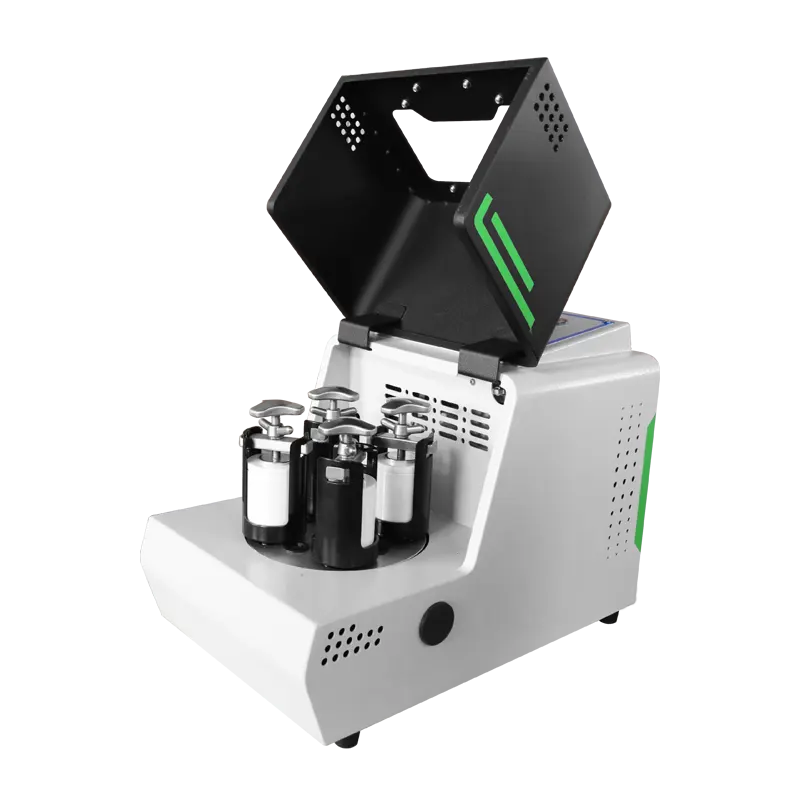
Pro Tip: Always match the media material to the jar (e.g., zirconia balls for zirconia jars) to prevent catastrophic contamination that can skew results.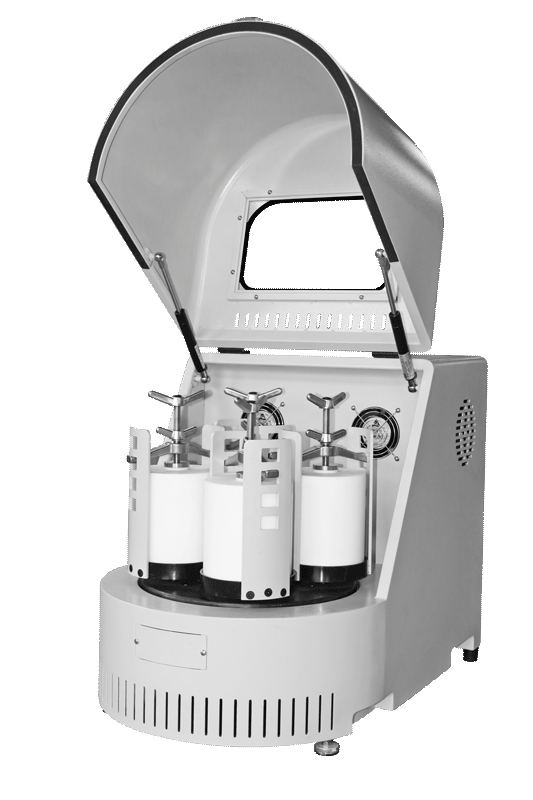 Planetary ball mill (semi-circular model) XQM
How much you load into the jar dictates the dynamics of the grinding process. Both the ratio of balls to powder and the total volume are crucial.
The Problem:
Low Ball-to-Powder Ratio (BPR): Insufficient grinding media means inadequate energy transfer and too few impacts. The sample cushions the media, leading to weak forces and poor, uneven size reduction.
Excessively High BPR: While seemingly powerful, an overcrowded jar restricts the free movement (cascading and rolling) of the media. The energy is wasted in media-to-media collisions rather than being directed to the sample, and heat generation increases dramatically.
Incorrect Total Fill Volume: The total volume of media and sample must allow for efficient motion. Underfilling leads to chaotic, high-impact but inefficient collisions. Overfilling stifles motion entirely.
The Solution: Optimize the Loading Parameters.
Find the Sweet Spot for BPR: The optimal Ball-to-Powder Ratio typically falls between 5:1 and 20:1. Start with a 10:1 ratio. For hard, brittle materials aiming for nano-size, increase to 15:1 or 20:1. For softer materials or coarser targets, a lower ratio may suffice.
Master the Filling Degree: The combined volume of grinding media and sample should occupy between 30% and 50% of the jar’s total volume. This is the ideal range for creating the cascading “waterfall” motion of the charge, which is essential for efficient and uniform grinding.
Calculation in Practice: If using a 500ml jar, the media+powder volume should be 150-250ml. Weigh your media, calculate its volume based on density, then add your powder accordingly.
Grinding is a kinetic process that evolves over time. Setting the wrong duration or using a continuous, monotonous cycle prevents uniformity.
The Problem:
Insufficient Time: The process is simply stopped before all particles have had sufficient exposure to the grinding forces. Larger particles persist.
Excessive Time (Over-Grinding): Beyond a certain point, particles can begin to agglomerate through cold welding or surface energy effects. Furthermore, excessive milling can induce unwanted phase transformations or generate so much heat that it alters the material properties, creating a new form of heterogeneity.
Continuous, Unidirectional Grinding: This can cause the charge to migrate to one side of the jar, creating zones of different grinding intensity and localized overheating.
The Solution: Employ Intelligent Milling Cycles.
Determine Optimal Time Empirically: Conduct a time-series experiment. Mill identical batches for 1, 2, 4, and 8 hours. Analyze the particle size distribution (e.g., via laser diffraction) after each interval. The optimal time is where the D90 (90% of particles are below this size) plateaus.
Use Programmed Interval Milling: Modern planetary ball mills allow for this critical setting. Program a cycle of 10-15 minutes of milling followed by a 2-5 minute pause. The pause allows heat to dissipate, preventing thermal degradation and reducing agglomeration tendencies. It often yields a more uniform product faster than continuous grinding.
Implement Auto-Reversal: If your mill has the feature, set it to automatically reverse rotation direction at set intervals (e.g., every 5 minutes). This prevents charge migration and ensures all material passes through the high-energy impact zones.
The rotational speed controls the centrifugal force, which determines whether the media cascade effectively or uselessly cling to the jar wall.
The Problem:
Speed Too Low: The centrifugal force is insufficient to lift the grinding charge. The media slide or roll at the bottom of the jar, generating only mild friction and minimal impact, resulting in poor and uneven grinding.
Speed Too High (“Critical Speed”): The centrifugal force pins the entire grinding charge (media and powder) firmly against the inner wall of the jar. No cascading or relative motion occurs. The media rotate with the jar, and zero grinding takes place, only heating from friction.
The Solution: Operate in the Optimal “Cascading Zone”.
Understand the Theory: The ideal speed is a percentage of the mill’s critical speed (where centrifugation occurs). For planetary ball mills, this is typically between 65% and 85% of the maximum rated speed.
Practical Test: Visually observe (if using a transparent jar demo unit) or listen to your mill. At the correct speed, you should hear a consistent tumbling or cascading sound. A low, rumbling sound indicates sliding; a high-pitched, smooth hum suggests centrifugation. Start at 70% of max RPM and adjust based on sound and result consistency.
Sometimes, the obstacle lies not in the process, but in the feed material itself.
The Problem:
Mixed Hardness in Feed: If your starting material is a mixture of components with vastly different hardness (e.g., a composite of metal and ceramic), the softer component will be over-ground into ultrafines while acting as a cushion, protecting the harder component from being ground at all.
Variable Feed Particle Size: Starting with a wildly inconsistent coarse feed (e.g., chunks mixed with powder) makes it impossible for a single set of parameters to act efficiently on all particles simultaneously.
Moisture Content: Moisture can cause powder clumping. These agglomerates behave as large, soft particles, grinding unevenly and often creating a paste that coats the media and jar walls, severely dampening grinding efficiency.
The Solution: Pre-Treat Your Feedstock.
Pre-Crush and Sieve: For highly heterogeneous or very coarse feed, use a jaw crusher or mortar and pestle to achieve a roughly consistent starting size (e.g., all below 2mm). This removes extreme outliers.
Process Components Separately: For mixtures of greatly differing hardness, consider grinding the hard component first to the target size, then carefully blending in the softer component for a final, short homogenization mix.
Dry Your Sample: Always dry heat- or air-sensitive samples in an oven or vacuum oven before milling. For non-sensitive materials, simple air drying may suffice. This prevents agglomeration and ensures the milling forces act on individual particles.
When faced with an inconsistent grind, follow this diagnostic sequence:
Inspect Media: Are they worn, or are you using a single size? → Implement a multi-size blend.
Weigh Your Loads: Calculate your BPR and filling degree. → Adjust to 10:1 BPR and 30-50% fill.
Review Your Program: Are you milling continuously for one long period? → Switch to interval milling (e.g., 10 min on / 2 min off).
Check the Speed: Calculate your operating speed as a percentage of max. → Adjust to ~75%.
Examine the Feedstock: Is it damp or wildly variable in size/hardness? → Dry and pre-crush.
Achieving a uniform particle size in laboratory ball milling is not a matter of chance or brute force; it is the result of a balanced and optimized system. By moving away from arbitrary “set-and-forget” protocols and understanding the interplay between media geometry, loading dynamics, temporal cycles, kinetic energy, and feedstock preparation, researchers can transform their mill from a source of frustration into a reliable instrument for precision powder engineering. Consistency in grinding is the foundation for consistency in all subsequent material properties. Master these five factors, and you master the first, critical step in creating advanced, high-performance materials.
4-拷贝-scaled.png)