
In advanced materials engineering, achieving a uniform and homogeneous particle size distribution is the fundamental prerequisite for synthesizing high-performance composites. However, researchers frequently encounter a critical physical limitation when utilizing standard vertical milling equipment: material settling. When processing materials with severe density discrepancies or components suspended in low-viscosity wet grinding mediums, heavier particles inevitably succumb to gravity. These dense particles sink and accumulate at the bottom of the grinding jar, effectively escaping the primary kinetic impact zones. This results in uneven grinding, localized overheating, and a failed synthesis.
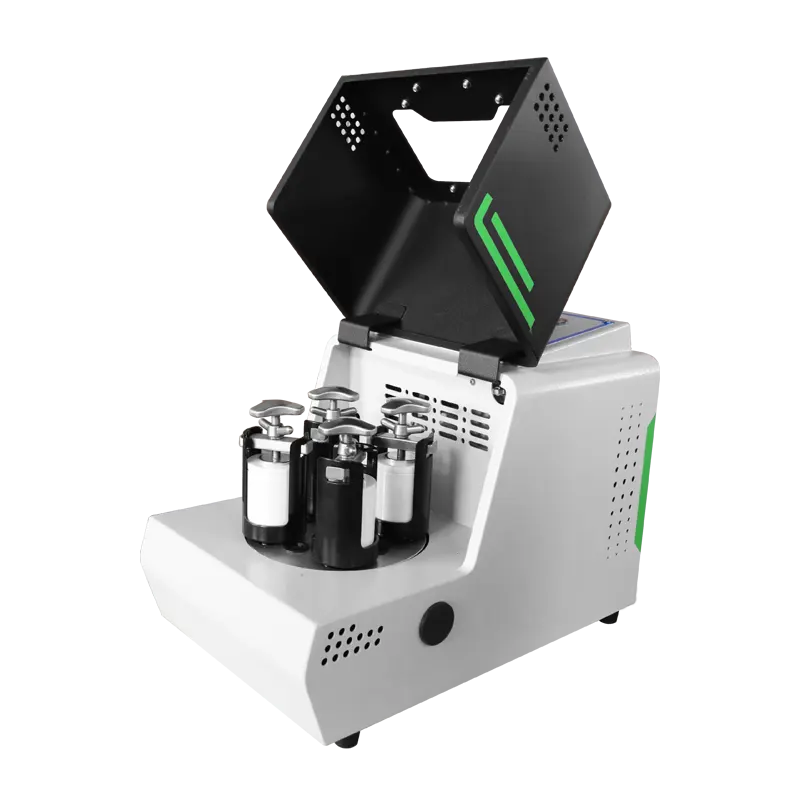
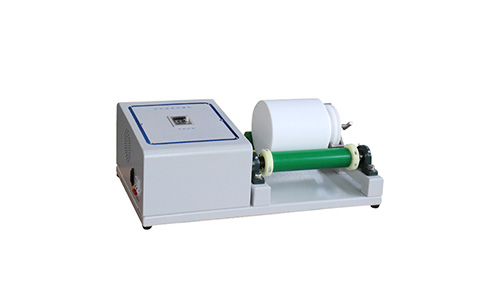
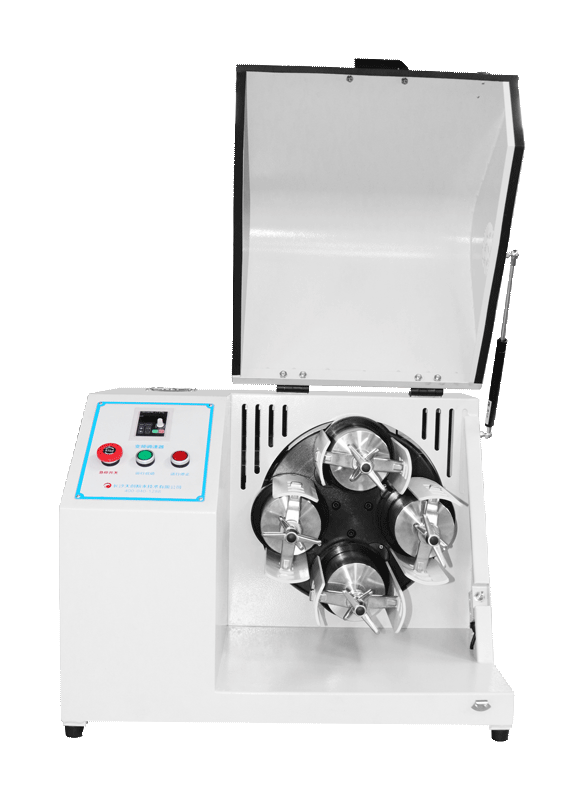
To directly combat this gravitational challenge, Changsha Tianchuang Powder Technology Co., Ltd. (TENCAN) has engineered the WXQM-2L Horizontal Light-Duty Planetary Ball Mill. By fundamentally altering the structural orientation of the planetary disk and grinding jars, this equipment neutralizes the settling effect, ensuring that even the most complex, disparate material matrices are subjected to relentless, uniform micronization. This article provides an in-depth analysis of the WXQM-2L, detailing how its horizontal architecture serves as the ultimate solution for high-precision laboratory grinding.
The ingenuity of the WXQM-2L lies in its physical orientation. In a traditional vertical planetary ball mill, the rotational axes are perpendicular to the floor. Gravity acts downward, parallel to the jar walls, encouraging dense materials to pool at the base. In stark contrast, the horizontal planetary ball mill aligns the rotational axes parallel to the floor.
As the primary sun wheel rotates, the individual grinding jars rotate on their own axes in the opposite direction. Because the entire system is positioned horizontally, gravity now acts perpendicularly across the diameter of the rotating jars. As the grinding media and powder matrix are lifted by centrifugal force, they reach a critical apex before gravity pulls them downward across the open space of the jar. This creates a highly dynamic, 360-degree continuous cascading effect. The horizontal structure specifically solves the problem of sinking to the bottom of partial materials by forcing the powder to remain in a state of constant suspension and aggressive kinetic agitation.
Procurement engineers and laboratory managers must evaluate equipment based on its operational reliability, acoustic footprint, and batch-to-batch consistency. TENCAN has integrated several proprietary engineering enhancements into the WXQM-2L to ensure it dominates in these critical metrics.
As previously established, the horizontal orientation is the primary advantage. For laboratories developing advanced alloys, heavy metal catalysts, or complex geological extractions, the WXQM-2L guarantees that heavy elements are continuously swept back into the active shearing zones. This leads to drastically reduced milling times and a significantly tighter particle size distribution compared to vertical alternatives.
High-energy planetary milling is inherently loud due to the massive kinetic impacts occurring within the jars. However, the WXQM-2L is equipped with TENCAN’s special drive gear mechanism. This exquisite workmanship ensures that the special gear operates with significantly lower noise, lowering the acoustic output by approximately 15-20 decibels compared to common gears. This noise reduction drastically improves the ambient working conditions within analytical laboratories without sacrificing any kinetic energy transfer to the sample.
In materials science, the ability to duplicate a result is just as important as the result itself. The precision-machined drive gear ensures a highly stable rotation speed. This operational stability guarantees the absolute conformity and repeatability of every experiment. A grinding protocol executed perfectly on the WXQM-2L will yield the exact same uniform granularity every subsequent time it is run.
TENCAN believes that robust industrial equipment should also be highly accessible and visually refined. The WXQM-2L features a 3D curve shape design that is both elegant and fashionable, elevating the aesthetic standard of the modern laboratory. Furthermore, the humanization design of the control interface ensures highly convenient operation. Technicians can easily program specific rotational speeds, set alternating forward and reverse cycles, and configure precise grinding durations.
The horizontal kinematics of the WXQM-2L provide the necessary kinetic environment, but the physical grinding accessories—the jars and the media—dictate the ultimate purity and efficiency of the process. Selecting the correct materials is an exact science designed to prevent cross-contamination.
To fully leverage the power of the WXQM-2L, laboratory directors must view their facility as an integrated ecosystem. High-efficiency synthesis requires that materials are protected and prepared correctly both before and after they enter the ball mill. Glove boxes and mixers are not auxiliary equipment; they are foundational, primary systems that define the absolute limits of a laboratory’s capabilities.
Before complex composite materials are introduced into the horizontal milling jars, they must be pre-homogenized. Utilizing an industrial-grade multidimensional universal mixer ensures an even dispersion of the precursor elements. Without this preliminary mixing, the kinetic energy of the ball mill may be wasted on uneven, segregated aggregates.
Similarly, when the WXQM-2L successfully reduces reactive metals or solid-state battery precursors to the nanoscale, the resulting particles are highly unstable and prone to immediate atmospheric oxidation. Transitioning these sealed milling jars directly into a high-purity TENCAN gas purification glove box is critical. By opening the jars and harvesting the powder within an automated, closed-loop environment guaranteed to maintain ≤1ppm of oxygen and moisture, researchers ensure complete environmental control over the entire material lifecycle.
The WXQM-2L Horizontal Light-Duty Planetary Ball Mill is a versatile powerhouse utilized across diverse, high-stakes industries. In the rapidly expanding sector of battery technology, it is deployed to process high-density cathode materials and solid-state electrolytes where gravity-induced separation would ruin the ionic conductivity of the batch.
In advanced ceramics, it facilitates the production of structural ceramics, piezoelectric components, and MLCCs by ensuring uniform precursor refinement. It is also extensively applied in the fields of geology, mining, metallurgy, electronics, construction material, chemical engineering, light industry medicine, and environmental protection. For any application where materials resist uniform dispersion due to disparate specific gravities, the WXQM-2L is the definitive operational standard.
The WXQM-2L, a best-selling model in this series, is designed with parameters that precisely balance processing capacity, grinding efficiency, and laboratory environment requirements.
| Parameter categories | Detailed Specifications | Technical Advantages Explanation |
|---|---|---|
| Basic Specifications | Nominal volume: 2L Workstations: 4 Grinding jar specifications: 50-500ml/piece |
The 4-station design offers high efficiency and flexibility. It can simultaneously grind and compare multiple materials, or place them symmetrically to optimize dynamic balance. |
| Electrical and Power | Power supply: 220V-50HZ Motor/inverter power: 0.75KW |
It uses a standard laboratory power supply and is plug-and-play. The 0.75KW motor provides ample and stable power for a 2L load. |
| Operation and Control | Revolution speed: 35-335 rpm Rotation speed: 70-670 rpm Total time: 1-9999min Alternating time: 1-999 min |
The branded frequency converter achieves stepless speed regulation and precise control. Its flexible forward/reverse and intermittent operation functions can optimize the grinding process for different material characteristics, further improving uniformity. |
| Grinding ability | Feed particle size: Soil material ≤10mm, other materials ≤3mm Discharge particle size: Minimum 0.1μm |
It meets the grinding fineness requirements of most laboratory samples, easily achieving the leap from micron to nanometer scale. |
| physical properties | Equipment dimensions: 700×510×570mm Equipment weight: 86kg |
Its compact body and solid weight ensure smooth operation at high speeds, with an operating noise level of ≤60±5dB, making it ideal for quiet laboratory environments. |
Running a vertical mill longer does not solve the physics of gravity. Dense materials will continue to pool at the bottom, leading to localized overheating, excessive jar wear at the base, and a highly uneven particle size distribution. The horizontal orientation of the WXQM-2L fundamentally changes the gravitational dynamics, solving the problem mechanically rather than just extending the processing time.
Yes. If the machine is matched with TENCAN vacuum ball milling tanks, samples can be ground in a complete vacuum state or backfilled with an inert gas like Argon. This is crucial for synthesizing air or moisture-sensitive compounds without oxidation during the high-energy milling phase.
To achieve high-efficiency grinding, TENCAN engineers recommend the universal “Rule of Thirds.” One-third of the jar volume should contain the grinding media, one-third should contain the sample material, and the final one-third must remain as empty headspace. This void allows the media enough distance to cascade effectively and generate the necessary kinetic impact force.
The WXQM-2L Horizontal Light-Duty Planetary Ball Mill represents a critical evolutionary step in laboratory powder processing. By completely neutralizing the gravity-induced material settling challenge, it allows researchers to synthesize complex, high-density composites with unprecedented uniformity and efficiency. With its ultra-low noise drive gear, elegant 3D curved architecture, and versatile multi-station processing capabilities, it stands as the preferred tool for uncompromising materials science.
When strategically combined with core infrastructural equipment like heavy-duty multidimensional mixers and high-purity purification glove boxes, the WXQM-2L enables laboratories to execute flawless, contamination-free research and development. Changsha Tianchuang Powder Technology Co., Ltd. (TENCAN) is dedicated to being the most trusted service provider of powder technology around the world, engineering solutions that empower the global scientific community to innovate with absolute confidence.